History

The Education Challenge

Since the early 1960s, Greenville County has been faced with a daunting challenge for higher education: how to provide access to public higher education for two-year college graduates who cannot leave Greenville County to pursue a four-year or graduate degree. As the exponential growth of the Greenville metropolitan area continued throughout the 1970s, 1980s, and into the 1990s, the scope of the challenge became evident as more industries began to explore the benefits of relocating in upstate South Carolina.

Now the largest metropolitan area in the state, Greenville County does not have a four-year public college or university within its borders. Although Clemson University (one of the state's two land-grant institutions) and the Spartanburg campus of the University of South Carolina Upstate are within an hour's commuting distance of downtown Greenville, neither institution is accessible to working professionals whose family and work responsibilities do not afford them the luxury of two-hour round trip to take daytime classes at a distant campus.

Rising to the Challenge

With the support of the Greenville Chamber of Commerce, a solution began to emerge in 1981 when Clemson University began offering graduate-level courses during evening hours on what is now Greenville Tech's main campus. Although Clemson had been offering a limited range of undergraduate courses at the Tech site since the mid-1960s, the University's graduate-level initiatives during the early 1980s underscored the growing need for master's-level programs for place-bound professionals.

In response to this need, Clemson University, with Greenville Tech's cooperation, invited other state-supported institutions to form a consortium for the Greenville area. After considerable planning and negotiation, the proposed new Greenville Higher Education Center was chartered by the South Carolina Commission on Higher Education, and moved into an office suite on the Greenville Tech campus. The new consortium officially began its operation on July 1, 1987.

With the governance structure and funding sources for the new consortium in place, the next challenge was locating teaching facilities of sufficient size to accommodate the consortium's projected growth. Greenville Tech helped the new organization meet this challenge by purchasing an abandoned factory adjacent to the Tech campus. Purchased, renovated and equipped at a total cost of $3.5 million, the new multi-story University Center of Greenville (as the original consortium was soon renamed) officially opened its doors in September 1989.

By 1993-94, the Center's member universities had increased from five (in 1987-88) to a total of seven: Clemson University, Furman University, Lander University, the Medical University of South Carolina, South Carolina State University, the University of South Carolina, and the University of South Carolina Upstate.

Virtually all sectors of South Carolina public and private higher education are reflected in the Center's roster of member institutions. In addition to South Carolina's three research universities (Clemson, the Medical University, and the University of South Carolina), the Center is also served by one historically African-American institution (South Carolina State University, a public land-grant institution), by a selective, independent undergraduate university (Furman University), and by two regional public universities with primarily undergraduate missions (Lander University and USC-Upstate). Together, these institutions deliver courses for 22 undergraduate and 36 graduate degree programs at the University Center.

Leadership & Operations

To meet emerging needs while achieving parity among the partner institutions, the Center is governed by a board of directors which comprises the presidents of the institutions, and an executive committee on which the institutions' chief academic officers serve. This governing board (which also contains representation from Greenville Tech) operates under the authority of the South Carolina Commission on Higher Education. Additionally, the Center's planning and development are supported by a board of visitors of business, industrial, and civic leaders in Greenville County. The chair and vice chair of this group serve on the board of directors as voting members.

Unlike some consortial ventures in other states, the University Center of Greenville operates as a collaboratively governed "mini-campus" in which all necessary instructional and student-support services are located under one roof. As a result, working professionals in Greenville County are at last able to pursue four-year, master's and doctoral degrees without having to disrupt their family lives and job responsibilities.

To provide but one example of the seamless access now afforded by the Center, prospective students can obtain the Associate Degree in Science at Greenville Tech, the Bachelor of Science in Business Administration from USC Upstate, and then a Master's in Business Administration from either Clemson or USC--all without having to leave Greenville.

The University Center itself does not award any degrees. Instead, the participating universities supply their faculty, and award the degrees. In 1992, the Center's team-centered philosophy led the state's two largest research universities, Clemson and the University of South Carolina, to begin co-teaching and co-awarding the Master of Public Administration degree--a first among two longstanding rivals on and off the athletic field.

The University Center's annual operating budget is derived from a membership fee, a state appropriation that includes operations, leasing and bond repayment, and a credit-hour charge paid by each public institution delivering courses at the Center. Since 1987, Clemson University has served as the Center's fiduciary agent for budget and personnel.  The authority and responsibility for developing and administering the annual budget, as well as for recruiting and evaluating all staff members, is vested in a Chief Executive Officer and an administrative staff. The partner institutions augment the Center's student services by assigning experienced faculty (usually at the Associate or Full Professor rank) and academic advisors to serve at the University Center as a part of their home-institution employment contracts.

Growth & Change

In 1993, the University Center's enrollment growth reached a critical mass that threatened to exceed the capacity of the current site. That same year, thanks to the generosity of a local real-estate developer (T. Walter Brashier), Greenville Tech became the recipient of a $5 million campus site ideally suited to the future growth of the University Center and subsequently leased by the consortium. After extensive renovation, this new facility was dedicated on September 12, 1996.

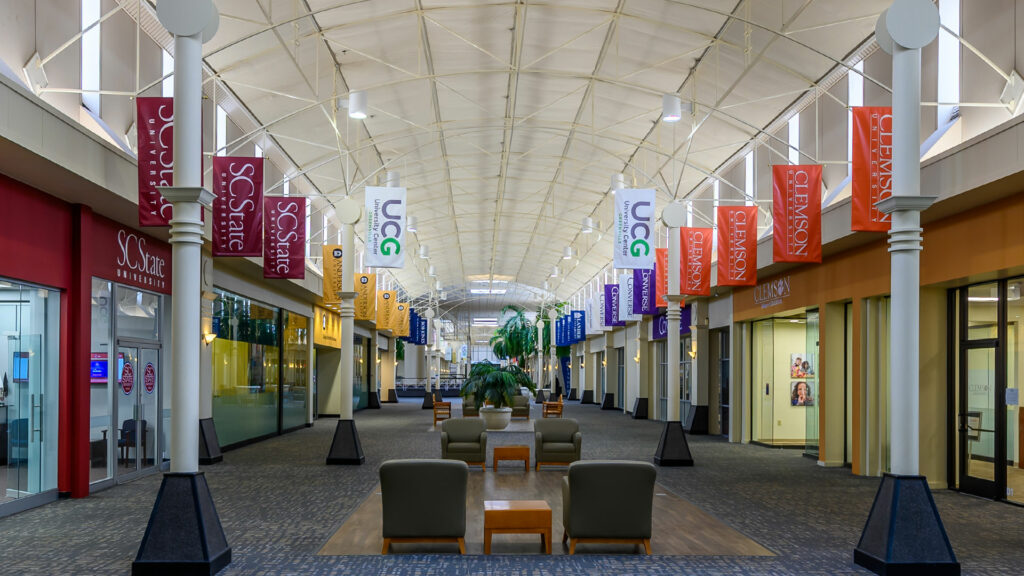
Increases in program offerings and enrollments again created the necessity for a larger facility.  In January 2001 the Center moved to McAlister Square mall across the street from the previous location.  The entire mall (600,000 square feet and 49 acres) was purchased by Greenville Technical College's Foundation, and a completely renovated (2001) 123,000-square foot space was leased by the University Center.  Future expansion will be into a second anchor space of 140,000 square feet.  The center of the mall is occupied by an assortment of businesses.

The revitalization of an older mall to house an educational enterprise along with commercial and service businesses is an innovative and economical use of real estate to meet a range of needs in the community.